A Revolt Against Education
What an 1881 countermovement means for what comes next

The Patrick Dempsey: #0111
(the Bilbo Baggins edition 😉)
I write weekly articles for educators who are ready to get unstuck from outdated curriculum, resistant institutions, and a career that was built for a world that no longer exists.
I go to Sky Zone regularly with our godson.
If you haven’t been, Sky Zone is an indoor trampoline park with obstacle courses, bouncy basketball and dodgeball, ziplines, super slides, foam pits, just FUN.
The whole thing is organized chaos.
Kids running. Everywhere. Making friends with other kids. Forming groups, playing games, making and intuiting rules. Laughing. Falling. Getting hurt. Feeling better. Figuring out how to navigate obstacles. Taking risks to do that next trick. Screaming. Sweating. Smiling.
It’s clear to me every time we go, that this is the natural habitat of children.
And it makes me wonder, why does school look nothing like this?
Island in the Sun
In 1881, a Dartmouth student named Ernest Balch founded Camp Chocorua on Squam Lake in New Hampshire—the first organized summer camp in America. In his own words, he deliberately planned it “to meet special educational needs” of the students who attended. Participatory, physical, ungraded, contributory. The boys governed themselves, cooked, cleared trails, built things. They had real stakes in a real community. By design, it looked nothing like a school.
Camp Chocorua itself lasted eight years. But it launched a movement.
By 1895 there were 11 camps in the United States. By 1918 there were more than 1,000. By 1922, Harvard’s former president Charles Eliot had seen enough of what the model produced to say plainly: “the organized summer camp is the most important step in education that America has given the world.”
Today there are upwards of 15,000 camps, with 26 million participants every year.
That’s a mass movement. That’s 140 years of parents looking at what school was doing to their children and paying to send them somewhere else for the summer.
Field of Dreams
The word camp comes from the Latin campus — which means field. Open ground. Boundless space. It’s the same root that gives us the word campus, which universities adopted to signal something about the relationship between learning and open space that the institution then spent centuries systematically enclosing.
In the pieces that brought us here, we traced four words back to their origins.
Learning — to follow a track, to move through the world finding your way.
Teaching — the paidagogos walking beside the child through actual experience.
School — skholē, leisure, time freed from production and given back to the person to use for becoming.
Education — educere, to lead out, to draw forth what is already inside.
Every one of them implied motion. Every one pointed toward something alive and moving through the world.
What Balch built—and what 26 million people a year are still paying for—is an environment where those words still mean what they originally meant. Less a curriculum. More a set of conditions. Real participation. Practice over performance. Fun as the foundation. Bodies in motion.
The science, it turns out, has been catching up to that intuition for decades.
Hungry Hungry Hippo
This section is almost too obvious to have to write. But it does seem we need a reminder:
Children (people generally) are not built to sit still.
When children move, their brains produce brain-derived neurotrophic factor (BDNF) a protein that supports neuroplasticity, memory, and learning. Exercise triggers its release. Sitting suppresses it.
Physical activity increases blood flow to the memory and learning centers of the brain. Which is why children who are physically active regularly have measurably larger hippocampi—the brain structure most central to learning and memory. The physical organ that does the learning is literally larger in kids who move.
You can restack that. 👆
The field of embodied cognition has been documenting what anyone who has watched children already knows: learning is grounded in the body. When information is tied to action—when you do something rather than hear about it—the brain encodes it differently, more deeply, and more durably.
Studies have shown that children who merely gestured while explaining math problems were 50% more likely to transfer that learning to new problems. Pairing words with physical movement improves vocabulary retention by nearly a full standard deviation.
The body is not a vehicle for transporting the brain to a chair. The body is the learning.
And yet we built a system that requires children to suppress the body entirely for six or more hours a day for 12 or more years.
Think about what we actually asked of children for 140 years. We put them in a room. We told them to be still. We told them not to touch anything that wasn’t assigned. We made them ask permission to use the bathroom. We gave them twenty minutes at lunch and, if they were lucky, 30 minutes at PE—and then wondered why they can’t focus.
We took the one thing that makes learning possible and called it a distraction.
What Learning Requires
To be clear, this is not an argument against technology in learning. At all.
Apart from its essential—and my favorite—role as a forcing function, AI has a legitimate and potentially powerful role in exactly the kind of contextual, embodied, contribution-based learning that learning actually requires.
And it’s not even really an argument for camp.
It’s really just a way of seeing that the thing that we’re defending in the face of AI disruption—is not worth defending. At all.
Better All the Time
I suppose that every post I make is really just trying to force us to admit that what we have is not worth defending.
Because, when we react against AI to preserve what it was like before it, here’s what we’re defending:
Sedentary learning. Age-segregated cohorts. Content delivered without context. Forty-five minute periods carved out of no logic. Single correct submissions with no iteration. Carnegie units that measure time in a seat and call it learning. Homework that extends the desk into the evening. A building that signals learning only happens here, in this room, from this person, in this direction.
Now set the neuroscience aside entirely. Forget BDNF and hippocampal volume and embodied cognition. Just look at your own life. Think about how you love to learn. How you love to live. Think about life from 0-5 when you learned to walk, socialize, tell jokes. Think about life from 17 (or 22) on and what learning in real time looks like and feels like. What motivates you? What disinterests you? How annoyed are you when HR sends that training that pauses the video when you try to switch tabs because you just can’t!
Now ask: if we were designing this thing called education from scratch, knowing what we know, would we choose this?
Would we think, “Here’s our very best ideas”: Let’s make children sit entirely still. Let’s pick 6 random subjects and teach them completely discretely from each other. Let’s force content disconnected from any real need or context, and then test whether they can repeat it back. Let’s do this for twelve years and call it preparation for life.
Nobody would design that. In fact, nobody did design it—at least not for learning. It all happened by accidents of history, responses to real needs at the time.
Which means, we have an opportunity to design something on purpose, for learning, to meet the needs of our time!
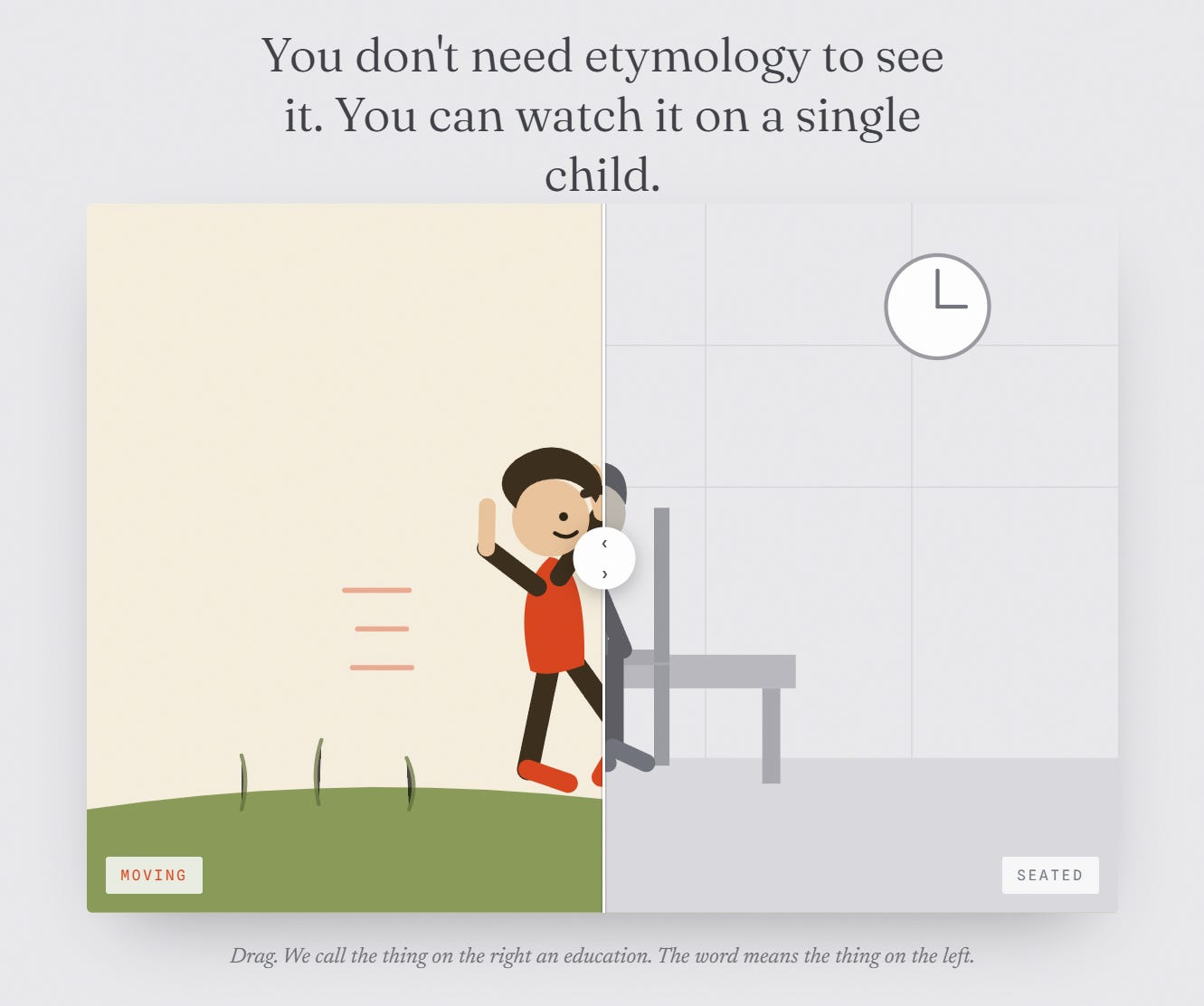
For paid subscribers: I turned this whole essay into something you can actually play with—an interactive piece called The Stilling. Drag a word from motion to stillness, slide a kid from the playground to the desk, watch creativity fall by the decade, and trace the movement out of any school word you can think of. It's the argument, made touchable (semi-meta). Link below 👇