
The Most Important Think I Built This Year
AI as forcing function and education's two choices

The Patrick Dempsey: #0114
I write weekly articles for educators who are ready to get unstuck from outdated curriculum, resistant institutions, and a career that was built for a world that no longer exists.
Grammarly and the Death of Society
“My students just use Grammarly and they just accept whatever it gives them. I want them to realize that Grammarly’s suggestions are wrong a lot of the time.”
I’ve spent a lot of this year speaking, consulting, and running workshops about AI in education—and that is certainly a line, or something like it, that I’ve heard more than once.
The objection about students using Grammarly is ostensibly about using AI, but there is something much deeper going on. The first few times I heard these sorts of objections, I wasn’t able to fully respond to them because I hadn’t really thought about what’s going on underneath the surface of that objection.
First, we should just note that if Grammarly is wrong a lot of the time, it wouldn’t exist. Obviously, that’s an absurd claim—similar to the AI hallucinates objection.
But here’s the main point, which is actually a question:
“Why? Why do you believe that students absolutely need to know something that you are recognizing the computer does for them? Why shouldn’t students use Grammarly?”
Surely, it seemed to me, if there was a reason it had to be more than for those few nuanced cases where someone who teaches writing for a living notices a nuance that Grammarly didn’t capture but which most average writers would be fine to simply overlook. Surely there had to be more than that!
But if so, what?
I’m Glad My Surgeon Didn’t Just Use GPT
A more direct and seemingly sturdier version of this objection, which is often bandied about, is the idea that we should glad our surgeon didn’t just use GPT to get through med school.
The point, of course, is that the result of an education should be competence. And that’s a fair point as far as it goes.
But it’s also a fatal objection for education more generally.
There is a decided difference between the medical board presenting someone who lacks professional competence in surgery with an M.D. and a high school or college course presenting someone who lacks relative competence in writing with a passing grade in composition.
In the former, of course, there is something of great consequence on the line—someone might die! Whereas in the latter, the consequence is felt mainly by the individual, and even then only questionably so—they never finished that novel!
I never took physics in high school and yet I have three master’s and a doctoral degree. Somehow the world goes on . . .
But the surgeon objection actually surfaces something fundamental that’s helped me articulate one of the most important things that I’ve found while navigating the challenge that is AI in education.
The Matrix
Through thinking deeply about the objection of Grammarly and of the surgeon, I realized that there is and indeed should be a difference in how we think about, design, and assess learning in fields based on the actual discipline and its consequences.
Clearly, an airline pilot should be able to demonstrate beyond any doubt their ability to operate an airplane. That should be verifiable in high-stakes situations, without external assistance, and across the repeated demonstration of both hard and soft skills.
On the other hand, History 101 . . .
You get the point.
There’s clearly a difference. At least we should recognize the existential difference between the two.
Now, this line opens up a whole other field of inquiry in terms of Instructional Design, Assessment, Accreditation, etc., but for now I want to focus on something narrower—what we’re defending in our disciplines with respect to AI.
To help explain my thinking, I created a two-by-two matrix that shows two things: objectivity and essentiality.
Objectivity — is there an actual right answer?
Essentiality — does getting the answer right actually matter?
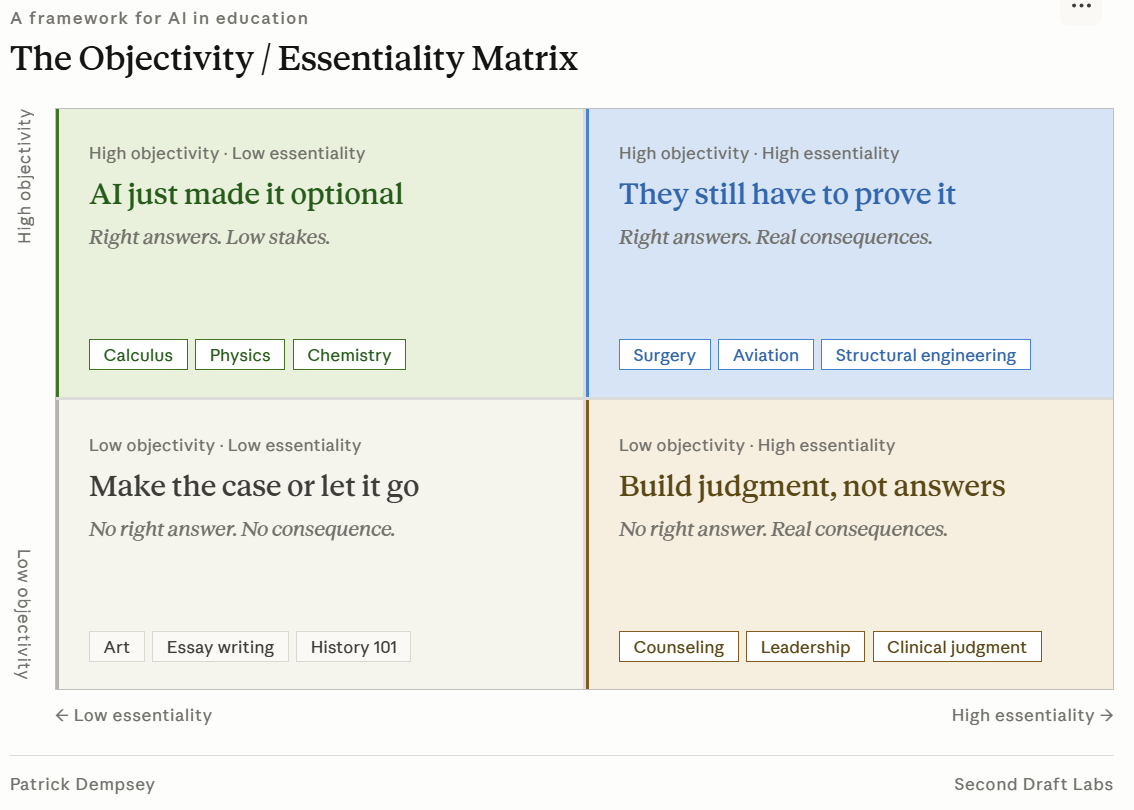
Let’s look at examples from each quadrant.
Something like art has low objectivity and low essentiality. There are many expressions of it and no universally agreed-upon stable definition of, let’s say, beautiful. It also has low essentiality because nothing really happens if you do a crappy finger painting.
Something like calculus has high objectivity and low essentiality. There are correct answers. However, for most people, it has low essentiality—I never took calculus and I’m fine; I can even moderately understand some relatively advanced statistical analyses (different, I realize, but that’s the point).
Something like counseling has low objectivity and high essentiality. There is no single correct therapeutic approach — multiple frameworks exist, practitioners disagree, and nothing objectively verifiable tells you in advance whether the method will work. But it has high essentiality because whether someone receives good care genuinely matters. People’s stability, and sometimes their lives, depend on it.
Something like surgery has high objectivity and high essentiality. The incision is either correct or it isn’t. The procedure either follows the right steps or it doesn’t. And it has high essentiality because something real happens to a real person if you get it wrong.
Highly Offended
Clearly this is offensive.
In our disciplines, we tend to want to believe that the thing we teach is just as important as anything else.
If we’re honest, it just isn’t.
So we’re left with that uncomfortable question, made even more uncomfortable still:
“Why? Why do you believe that students absolutely need to know this thing?”
With my background in instructional design and my own experiences as a student, this question has always been at the center of my work.
Here’s what I’ve found after working with hundreds of educators and completing nearly 400 credit hours in higher education.
Teaching is almost entirely idiosyncratic. That is, the content and approaches of educators are based on little more than whim and fancy.
Of course, most educators teach similarly and rely on the same standard assessments with the same mindsets behind them—viz. provide content they think is important and then create something difficult to see who really “gets it.” And, most often, the things these assessments get at are not the things related to the content as such.
Essays, high-stakes exams, oral defenses, etc.—all of these measure, perhaps even primarily so, things other than the content proper. This is all reflected in the grading of the assessments, with even rubrics accounting for things not directly taught and even less frequently objectively defined.
In many ways, courses function as hobbyhorses for educators—spaces to impart the wisdom and worldviews that the instructor believes are key to success in life. This is why something such as “writing is thinking” has such adamant proponents—it’s more faith in something they believe to have been formative for them than a reasoned and defensible position that is universally true and necessary.
So courses are idiosyncratic in the very real sense that they are based on little more than the vibes of the educator, and almost essentially so as we have seen. Because, with the exception of a few disciplines—and more specifically, a very narrow set of KSAs within those disciplines—there really is no objective standard, and even if there is, there is very little essentiality to it in most disciplines and across most KSAs.
Yeah, there’s a whole other series coming out of that paragraph!
Just Admit It
And this brings us to the point where we have to admit what’s happening.
For a lot of educators, the discipline itself has low objectivity and low essentiality. And that makes a tough sell for why writing the essay without Grammarly is important.
And even for educators in disciplines with high objectivity and high essentiality, because a lot of what is taught and expected is not actually content-related and even if it is how it is taught and assessed lacks legitimacy, there is again a lack of believability from students on why they need to do such and such a thing when AI seems fully capable of doing it.
And that leaves educators with basically two choices.
And those choices are what we’ll explore in the next article.
I'm curious how this lands in your seminars and consulting gigs - these are very uncomfortable questions for many educators and, as a history teacher, I see where you are coming from. I do agree, on the one hand, that teaching is highly idiosyncratic and the privilege of the closed classroom door is one of the secrets of education - what happens in your room, for the most part, is your province. But, and I do believe this, young people need to know the constitution and their rights and the key critical facts about our country's history - I get that you are claiming it is low essentiality, but look around and ask yourself if that is really true - look at the consequences of the majority of our citizenry not understanding how government functions and how it works. Maybe not knowing calculus and not understanding physics for the average person is not a huge deal, but when we don't know basic truths about how democracy is supposed to function and how and where we've made mistakes in the past, well, I don't agree that isn't essential. In any case, this is provocative stuff. I'm really curious how your views are landing with teachers. BTW - I agree with you on Grammarly - why wouldn't we want kids to have their written work corrected?
I really like this matrix! It’s something every educator can use to examine their own discipline and its associated forms of assessment.